


Making Space for Creative Work
Designing a workspace that supports you in your craft
Picture the best work you’ve ever done and where you did it. (Ideally, not the work you crammed in just before a deadline, or the project that made you cry and question your worth as a maker.) Think of a time when you were working and felt inspired, creative, excited and proud of yourself.
We’re all capable of creativity, innovation, and productivity under the right conditions.
As a psychologist, creative entrepreneur, and someone who loves a good deep-dive, I explored how different conditions in our work spaces can impact our thinking, creating, and (well)being. And this letter is about weaving some of those conditions into your workspace.
Happy Chaos
We get so many messages about what a productive, creative workspace is supposed to look like. As I shared in the Myth of the Messy Desk letter, we tend to think we will be more productive in minimalist or Instagram-ready spaces. In reality, though, when researchers have tested performance and creativity, these factors didn’t actually matter like we’d thought.
So what does?
Economist Tim Harford challenged the idea that disciplined and serious work should fit the cool, minimalist aesthetic. One case study he named was MIT’s Building 20. And goodness Building 20. Many have found this rabbit hole before us, but if you’re new to it, give this a moment. It’s really cool.
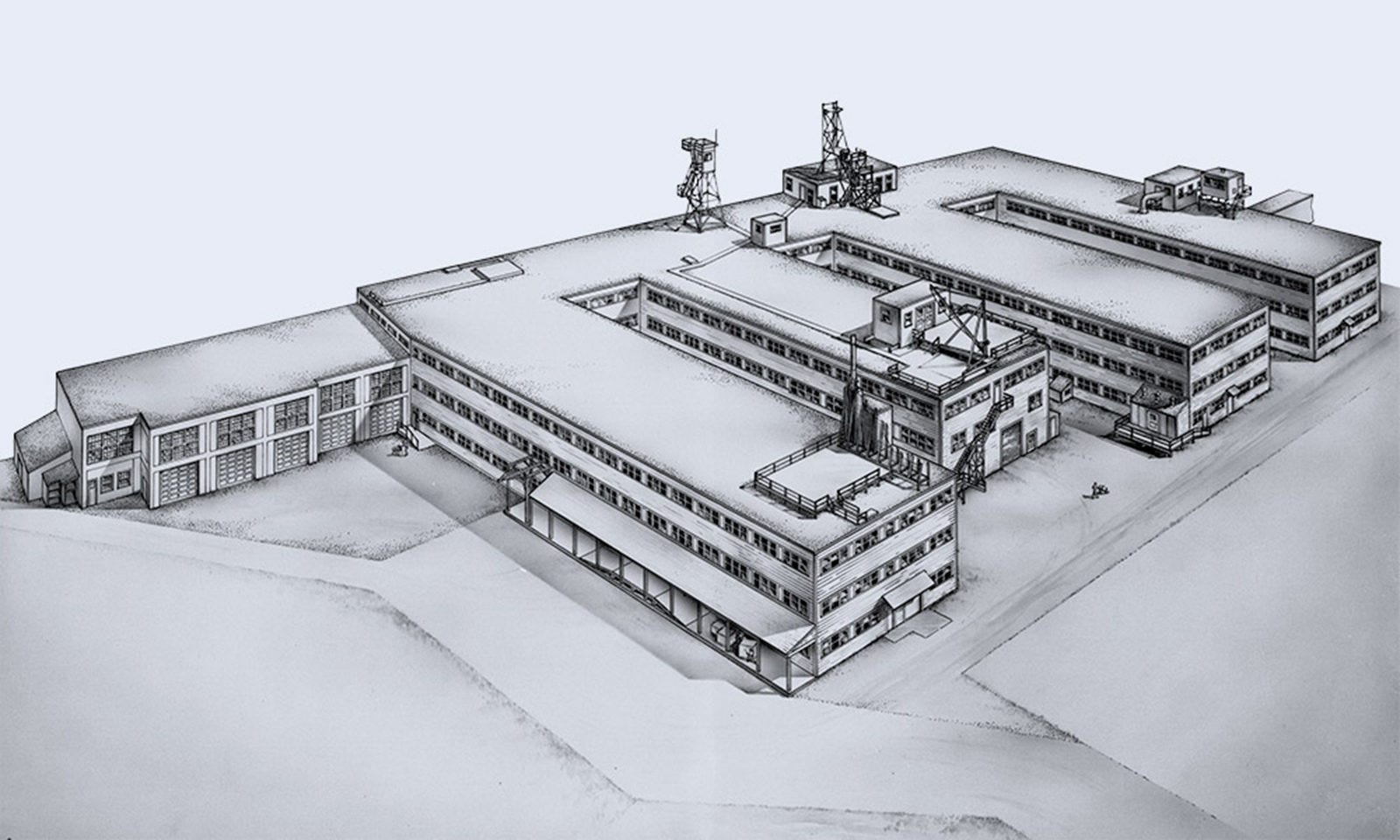
Building 20 was known for exposed pipes, MacGyver-style wiring, and long, winding halls. It became the drop spot for MIT’s Naval research, photography materials labs, anthropology and linguistics, electronics and acoustics labs, nuclear science labs, a piano repair shop, the Tech Model Railroad club, and even Noam Chomsky’s office.
The winding corridors and shared, slightly chaotic space produced serendipitous run-ins between people who would otherwise have had no professional reason to connect. Neuropsychologist Jerome Lettvin described working there as being part of a “womb of ideas” where “you could always pop over next-door and talk with somebody who had nothing to do with what you were doing. Simply because everybody had a passion for what they were doing.”
Others also referenced working on things for the joy of discovery. And, some of the most significant scientific and technological breakthroughs of the 20th century came out of it.
Over time, we’ve confused order with productivity and mess with failure, but stories like Building 20’s show us that the relationship we have with our environment is actually far more interesting.
Den or Meadow?
We know that our performance on tasks improves with the right level of stimulation - we call this the Yerkes Dodson law for fellow nerds. At a certain level of difficulty, we perform better on challenging, deep-work tasks if we are less stimulated. It can therefore be helpful to have a work space you can retreat to that is more insulated from sound or distractions. We’ll call that your “den.”
For repetitive, familiar, well-practiced, or boring tasks, we actually benefit from more stimulating environments to get us activated enough to perform well and stay productive. We’ll call this sort of space your “meadow.”
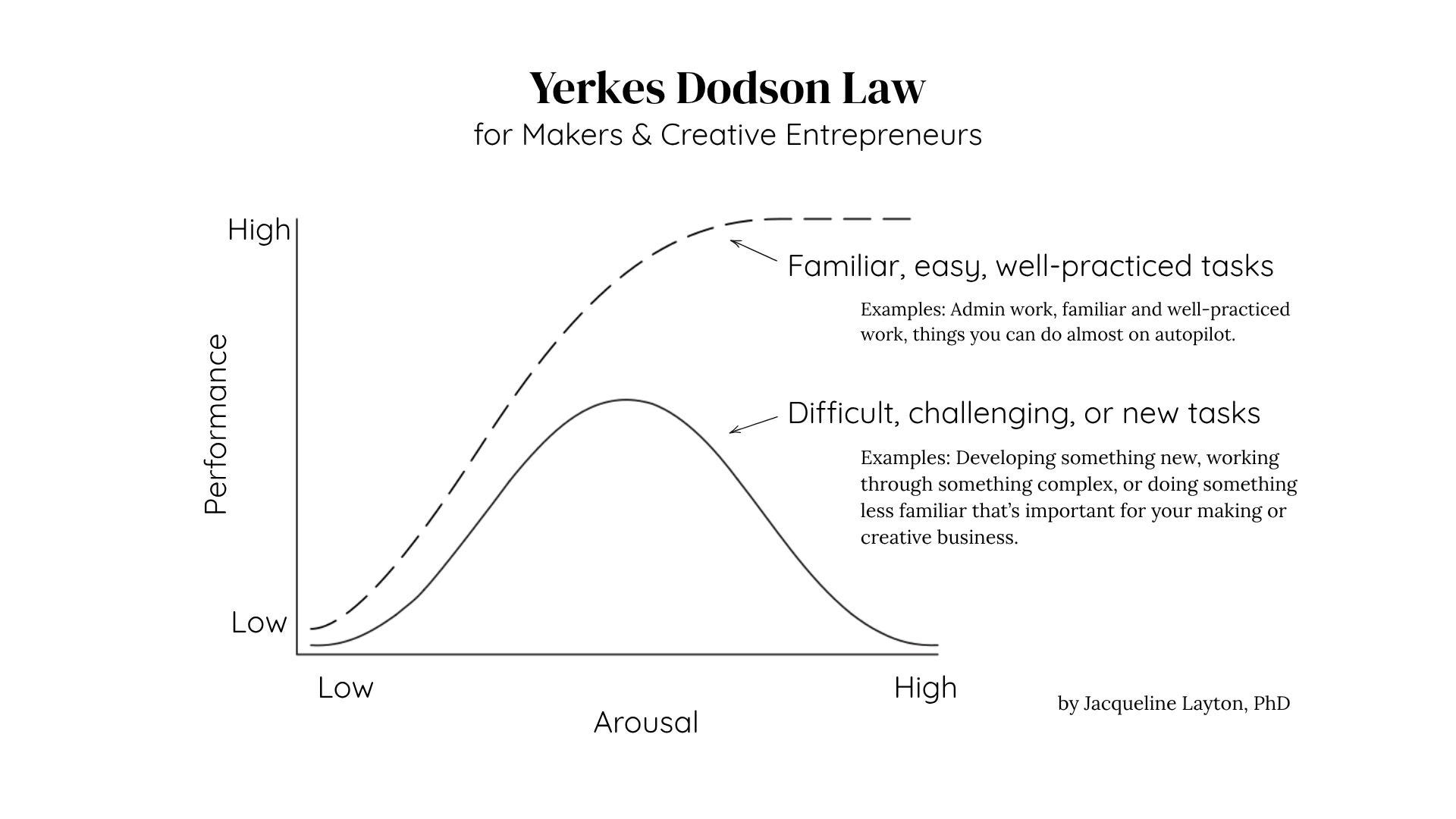
The den is soothing. It's where you tuck yourself away for deep work, and protect yourself from interruptions. You may retreat to your quieter, comforting space to develop something new (e.g., initial concepts for brand identity, a new visual style for a shoot), work through something complex (e.g., writing an emotionally vulnerable scene in your book), or do something less familiar or comfortable (e.g., pricing and valuing a new project for the first time).
The meadow is energizing and connected. When you are working through routine or lower-stakes work such as admin work (e.g., transcribing notes, scheduling social posts, replying to emails), and familiar, well-practiced work that you can almost do on autopilot (e.g., resizing assets for different platforms, stretching canvases, updating a style guide or a spreadsheet) - some added energy and stimulation helps. This is where people nearby can keep us focused (e.g., a co-working space). Another option to connect in your meadow is by signing into a virtual body doubling call to stay motivated and productive.
Safe to Make
We do our best thinking, learning and creating from a place of psychological safety. When our nervous system registers a space as safe, we’re able to think more openly, take creative risks, and tolerate the uncertainty that real problem-solving requires.
But how do you cultivate that?
Autonomy
One of the most important conditions for creative work is autonomy. By this I mean both the autonomy to create your den and meadow, and the autonomy to move between them as needed. Researchers have found that when we are given only one kind of space (all-open or all-private), our work satisfaction and output both suffer.
There’s also something about the autonomy to impact, personalize, and move within a space that challenges the hierarchal power we can otherwise feel in workspaces. Hierarchies can stifle creativity. If your space feels like a reminder that you are working or performing for someone else, that your space and movements need to be approved by someone else (even clients) - that power can feel inhibiting in your creative work. This felt oversight can also drain our cognitive load, inhibit our willingness to take risks or challenge norms, and can lead to us having more rigid thinking. All not great for creatives and makers, right?
This is about having permission to build and environment that reflects and supports the human doing the work in it.
Make it Personal
To personalize your space with intention, start with your own associations.
Think back to the settings and times where you’ve felt happiest, safest, and most inspired. Can you bring any reminders of these places, people, or experiences to your workspace? It can be big or subtle, lavish or on a budge. It's the attempt and resulting feeling that count.
I’ll get to some helpful factors and elements to consider when personalizing your space in a moment, but there’s no universal standard for an ideal creative space. This is about what feels safe and welcoming for you personally.
You’re creating a space that tells you each time you enter it that this space is yours and for you.
Research has supported that having sketches, visual illustrations, models or other “creative artifacts” around you in your space can facilitate your creative process. Some researchers have even described spatial elements as “resources for creativity.”
Our collected and sentimental items or art also matter because of how they can impact how it feels to work and be in our space. Space is not just physical, but also a lived experience. Having some things in our spaces can subtly encourage creativity and autonomy in the space - like a communication of permission while there to get creative yourself.
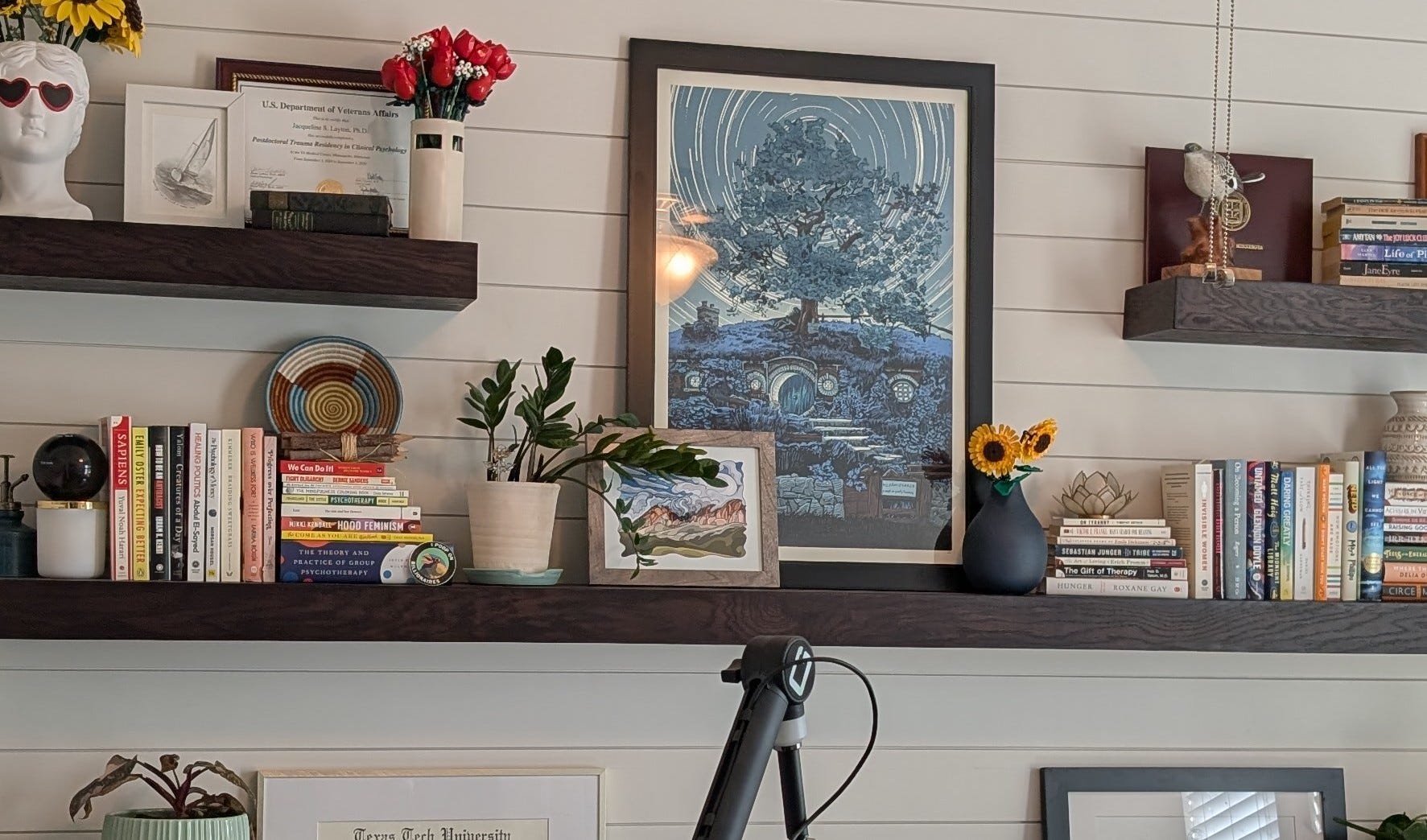
As an example that works for me personally, my own office looks nothing like the sterile, fluorescent-lit clinical settings I trained in. There’s a print of the Shire behind me, a Jurassic Park LEGO set my daughters play with, photos of my kids and partner, plants in every direction, and a lot of natural light and color. For me, it’s a reclamation of what professional space is allowed to look like. And I feel happy in this room, which matters for productivity too.
Sensory Elements to Consider
Environmental psychologists have pointed out a number of helpful factors to consider: color, natural light, and visual and auditory privacy. Calming colors like green and blue-violent can support a relaxed state good for incubating ideas in your den according to some research. Vibrant colors like yellow, pink, red, and orange can act as a spark in your meadow. Google has ping pong tables and unapologetically bright, weird office aesthetics to promote creative innovation. You get to have your quirky, happy space too - whether that’s a wall of counterculture hand-painted skateboard decks, your massive bobblehead collection, or a gallery wall of art and vintage thrifting finds.
In his book, The Best Place to Work, Ron Friedman offered ideas for your meadow. He wrote that big rooms with high ceilings may prime bigger thinking, and a little ambient noise at a coffee-shop level can help nudge us towards more abstract thinking and creative processing.
Even in our dens, though, some noise in helpful. Music or soft ambient noises, the sounds of birds outside, and other such “positive” sound can support rather than distract us in our creative work. Total silence on the other hand can put us on edge (believed to be an old evolutionary tripwire since a silent environment happens when a predatory is near).
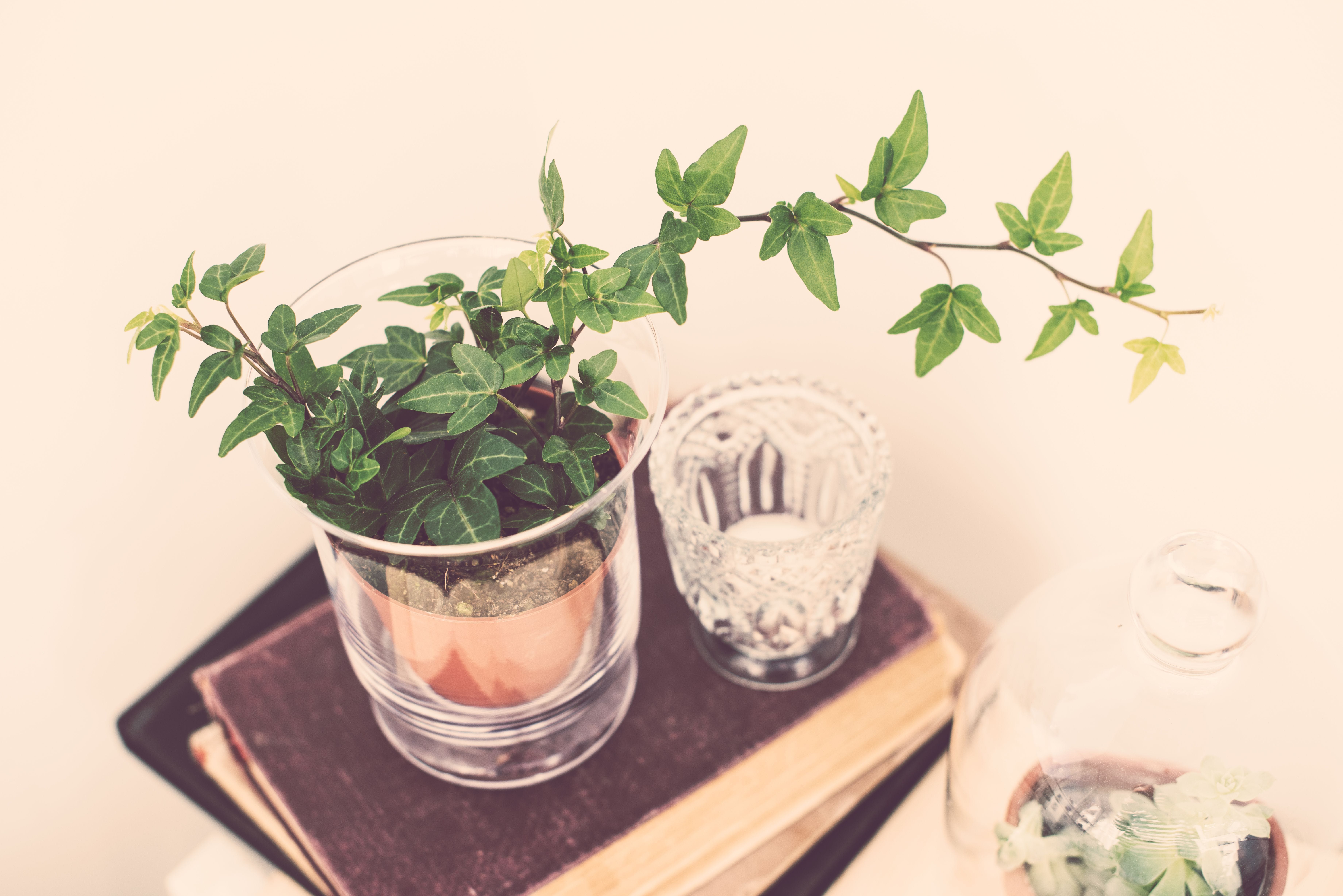
In both dens and meadows, daylight and the visual presence of nature and plants show up again and again in the research as measurable supports for creativity, reducing stress, and promoting your wellbeing. This is probably why Apple has moved from its old bare-white-room stereotype to sites like their Cupertino “Spaceship” campus that has massive walls of windows overlooking nature trails and green space, as well as trees planted both inside and out.
Improving the health of your environment, if possible, can also help. Workers in green buildings - meaning ones that are intentional about air quality, light, and temperature - also tend to have fewer sick days, higher retention, and better productivity. If you can, let a fresh breeze flow through, keep the room 75°F (25°C) or cooler, and check your detector to ensure CO2 levels are lower than 600 ppm (even though the allowed limit is supposedly 1000 ppm).
Natural elements (e.g., wood and especially the texture of wood grain) have also been found to have positive associations with creativity and composite materials (e.g., plastic, carpet, laminate) are negatively associated. These do not appear to be as important as autonomy and how we feel in the space, but if it’s within your resources, these can be helpful elements to consider as well.
We All Bring Bags
Let’s talk about when making space feels risky. Many of us have received messages - intentionally or not - that founder spaces, creative spaces, or the professional spaces we offer services or consulting in may not be welcoming for us. And we bring those experiences in the world with us into our space as well.
You may feel pressure to present a certain way to challenge or even compensate for how society treats your work or people who share your identities. Sometimes we hold back from personalization or expression out of self-protection.
And as much as I get that, there’s a cost too. It reinforces the message to some deeper part of yourself (perhaps your “inner child” or “inner creative”) that you are not fully safe to be yourself in this space.
Luckily, you don’t have to create the ideal space for yourself all at once. Do what you can with the resources you have right now. This can be a gradual process that grows as you do.
You also don’t have to do it alone. This brings me to the final and perhaps most important part of creating a space for yourself.
Build Your Tower
In 1927, A’Lelia Walker turned part of her Harlem townhouse into a salon she named the Dark Tower, after a poem by her friend, Countee Cullen, a black, queer poet and novelist. Zora Neale Hurston, Langston Hughes, and W.E.B. Du Bois all wrote in their private spaces and connected with fellow artists and revolutionary minds in the Dark Tower.
There were gold walls, velvet cushioned seats, a sky-blue record player, and a rose colored piano. This space had a sense of place and it was theirs. For black and queer creators, the Dark Tower offered a rare space at the time. It wasn’t just a meadow, but a safe meadow.
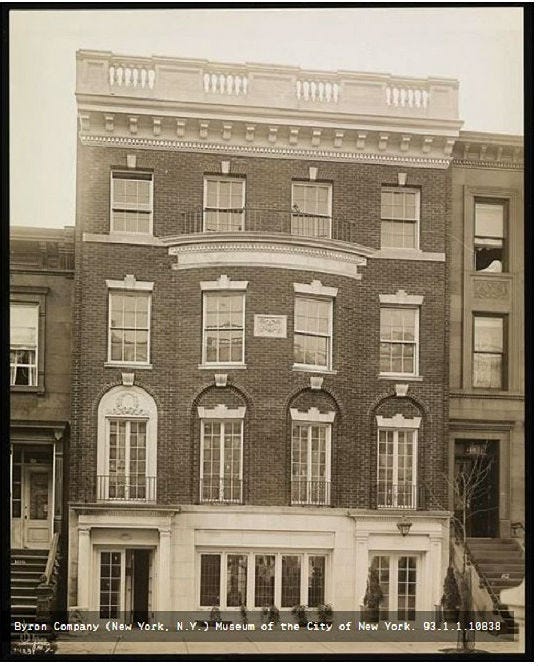
Her great granddaughter A’Lelia Bundles described how the parties A’Lelia Walker threw here “had all artists, musicians, writers, actors who were part of the Harlem Renaissance, but it was also the newspaper publishers, the Civil Rights leaders - everybody, at some point.”
I don’t want you to read this and think your meadow has to have high style, massive space, or a crowd of geniuses, activists, changemakers. (Though I mean, if you can that would be amazing!) What we need is to genuinely feel that there are people around us who are there to celebrate with us, comfort and encourage us, and be a reminder that we aren’t alone. And for us to get to be the same for them. That may be a warm, low-stakes coworking group. It might be friends who also run businesses and get it. Or a local artists networking group. It doesn’t have to be big. It just has to be real.
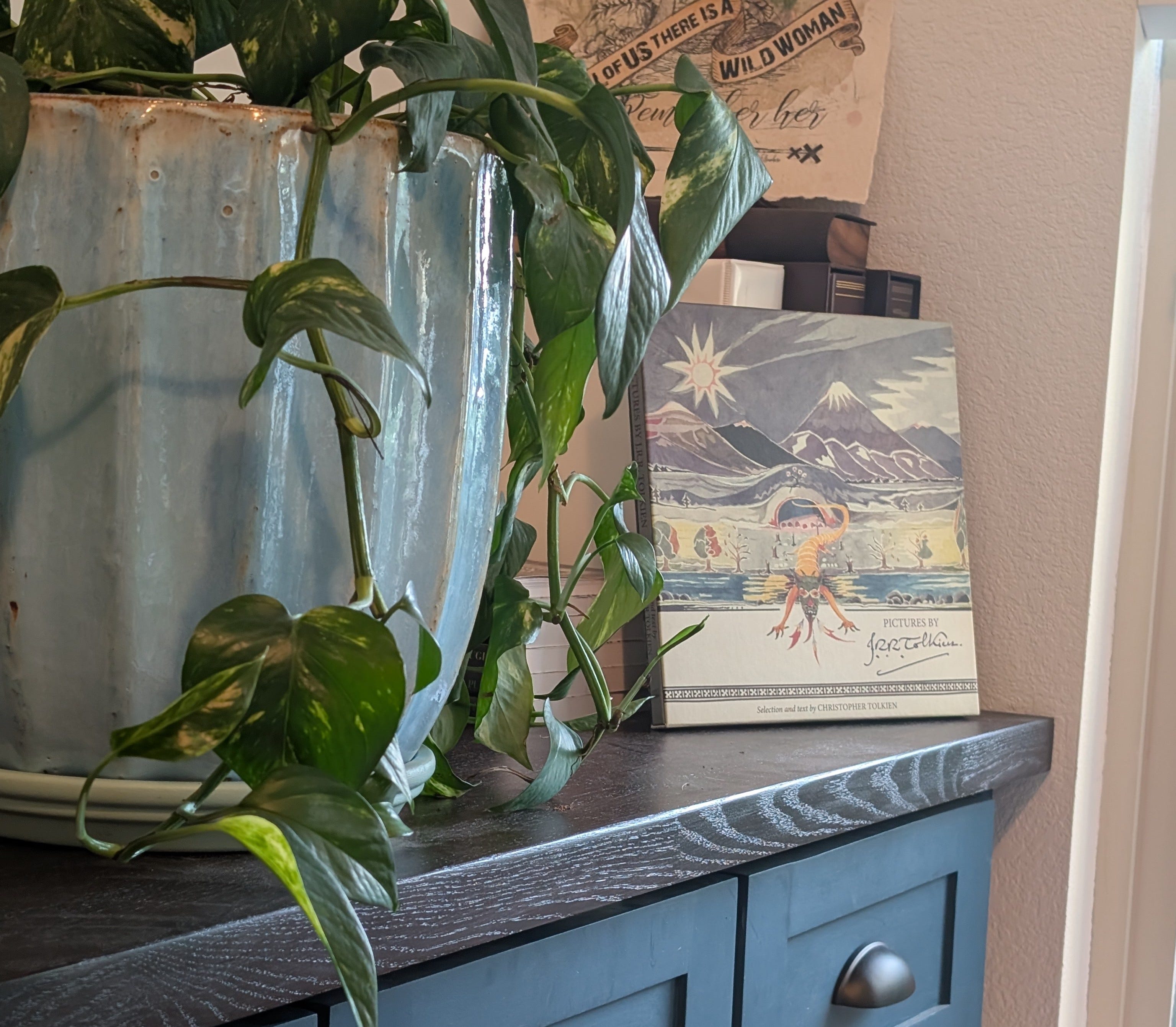
While J.R.R. Tolkien worked on The Lord of the Rings, something that took him over a decade to complete, he and a handful of friends, including C.S. Lewis, formed the Inklings (an informal literary discussion group) and met regularly at a pub. Tolkien later credited those casual visits, and Lewis’s encouragement in particular, with helping him actually finish the book.
I hope, someday, Beneath the Making becomes something like that for you and others - a space for curious, heart-led, creative people in our full humanity and neurodiversity. I’d love to gather us together and create a kind place to serve as our oasis in an increasingly authoritarian world. Together we can create a space that protects and believes in making - and in the sort of creative entrepreneurship that leaves us feeling whole, stable, and fulfilled.
The Big Takeaway
For a space to welcome your creativity, your innovation, and your productivity, it has to welcome you first. A good space is one that supports the human working in it. You deserve an empowering space where you can truly feel you belong.
Until my next letter, I wish you warmth, community, and a sense of place. It’s not just your work that our world needs - it’s you.
-Dr. Jackie
Some Sources for the Curious
[Link to Review] Blomberg, A. J., & Kallio, T. J. (2022). A review of the physical context of creativity: A three-dimensional framework for investigating the physical context of creativity. International Journal of Management Reviews, 24(3), 433–451.
[Link to Review] Clements-Croome, D. (2015). Creative and productive workplaces: a review. Intelligent Buildings International, 7(4), 164–183.
[Link to Book] Friedman, Ron. The Best Place to Work: The Art and Science of Creating an Extraordinary Workplace. TarcherPerigee, 2014.
[Link to Review] Meinel, M., Maier, L., Wagner, T., & Voigt, K.-I. (2017). Designing Creativity-Enhancing Workspaces: A Critical Look at Empirical Evidence. Journal of Technology and Innovation Management, 1(1).
[Link to Chapter] Suckley, L., & Nicholson, J. (2018). Enhancing Creativity Through Workspace Design. In L. Martin & N. Wilson (Eds.), The Palgrave Handbook of Creativity at Work. Palgrave Macmillan
[Link to Article] Zohar, N., & Bernhardt-Walther, D. (2026). Pretty useless? Aesthetic appeal of office images is associated with anticipated but not objective productivity. Journal of Environmental Psychology.
The Dark Tower Specifically:
When I travel down this rabbit hole, the works and people and scene is so full of beauty and hope but also grief and rage. If you dive down this one, I wish you a warm fire of solidarity and - even though Countee Cullen wrote in “From the Dark Tower” that “we were not made to eternally weep,” I think seeing the community and creativity of 1920s Harlem at that time from where we stand in our current point in time can bring up a lot of pain. The arc of justice sometimes runs so very very long. Hopefully we as a society can learn from those who came before us as we imagine a kinder and more inclusive way to hold one another.
[Link to Poem] “From the Dark Tower” by Countee Cullen
[Link to Article] Carolyn. (2020, October 14). A’Lelia Walker’s legendary Dark Tower in Harlem 1885 - 1931 (photographs). Harlem World Magazine.
[Link to Article] Walser, L. (2017, March 29). How A’Lelia Walker and the Dark Tower shaped the Harlem Renaissance. The National Trust for Historical Preservation.
Building 20 Specifically:
[Link to Article] Beam, A. (1988, June 29). A building with soul. The Boston Globe. Reprinted in MIT News, October 30, 1996.
[Link to Article] Fox, Kathleen. “’The Magic Incubator’: MIT Building 20 (1943–1998).” The Cambridge Historical Commission Blog, March 24, 2026.
[Link to Page] “Subject: Building 20.” MIT Museum Collections.
Mini Documentary: MIT’s Building 20 “The Magical Incubator” at