The Stories We Tell Ourselves About Being Good Enough

The Stories We Tell Ourselves About Being Good Enough
Why even award-winning creatives don't feel like enough sometimes
Makers and creatives often share a strange experience, even after years in our craft, of uncertainty about whether we are good enough, whether we truly belong, and whether others will see us as imposters.
And it isn’t just creatives. Leaders, mentors, agency owners, and founders - we all experience this from time to time.
Feeling like an imposter doesn't mean you are one - it’s not actually a measure of your competence or “enoughness” as a creative. But if you’re here reading this letter, I'm guessing that reminding yourself, “I am enough, and I belong here,” hasn't worked on its own.
So let’s talk about:
- Why we experience imposter phenomenon in the first place
- Layers left out of common imposter syndrome advice
- How we can actually counteract this
So Why Do We Experience Imposter Feelings?
In short, our brains are storytellers.
It’s our process for taking in the constant flood of information and making meaning. Our working stories help us summarize what’s happening, what it means to us, and what we can expect to happen next. But those stories can be incomplete, inherited from sources who do not deserve authorship in our lives, or even harmful to us.
In 1978, psychologists Pauline Rose Clance and Suzanne Imes coined the term “imposter phenomenon” to describe the experience of doubting your abilities, worrying you’ll be seen as a fraud, or questioning whether you truly belong. And nearly 50 years later, we’re still talking about this.
In my work with people experiencing imposter phenomenon and impostorization (an experience of imposter feelings brought on by systems, structures, policies, and practices in our sociocultural environments), there are several layers - individual, historical, social, and cultural.
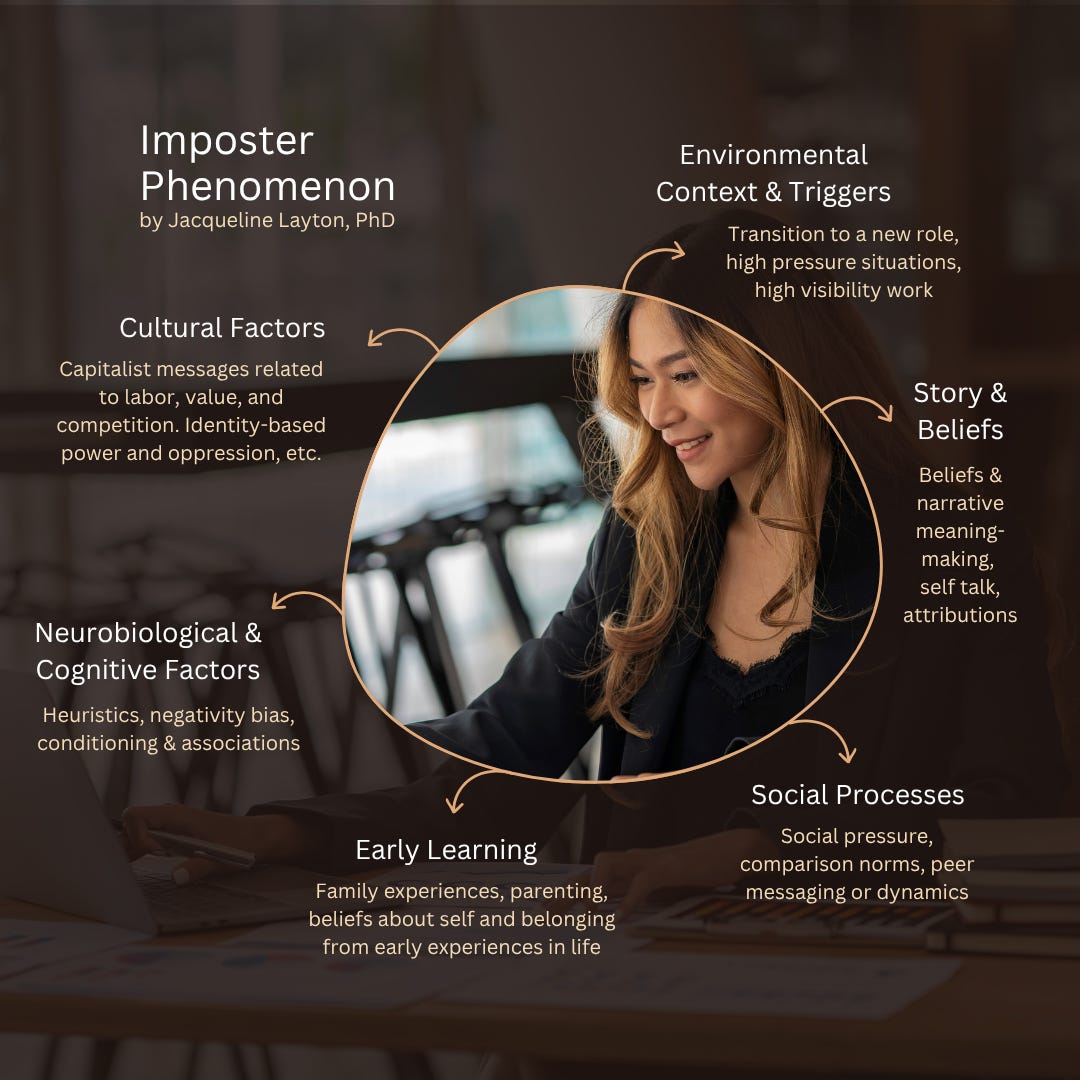
Let’s start with the cultural factors because -
A Huge Part of this is Systemic.
In this job market so many people are experiencing layoffs, and I personally know very competent and lovely people who have applies to hundreds of jobs. So many creatives are bidding on projects, only to be rejected. So many are being told that this work done cheaper elsewhere or with AI. And I’ve heard people look at these rejections and tell the story: “I’m not good enough.”
It’s not based on nothing. There was rejection and that rejection hurt. But the conclusion may leave out some pretty important things.
For instance, neurodivergent creatives (e.g., creatives with ADHD or autism), women, and people of color report higher rates of rejection, burnout, and being denied opportunities. More report being stuck in a creative role or in creative projects beneath their actual skill and experience level. Some imposter syndrome isn't a syndrome at all, but what psychologist Angélica Gutiérrez called imposterization.
Some of us develop stories that we’re imposters because we have experienced being treated like imposters over and over again.
So even if part of us thinks that is unfair and knows we’re good at what we do, we can dread how we will be treated or perceived. We can worry others will think less of our work or dismiss us.
Unfortunately, due to this, your brain isn’t the only author. Our schools growing up, institutions, workplaces, markets, and culture all come in, scribbling their stories and beliefs into our ongoing narratives. When you are exposure to the beliefs of a culture each day - from the subtle to the overt - it’s hard not to accidentally weave some of these into the stories we tell about ourselves.
If your design client repeatedly question your prices, you may summarize this as:
Maybe I’m not good enough to charge this much.
But there are other possibilities her too. It’s possibly your price needs adjusting, but it’s also possible that your offer isn’t communicating its value clearly enough, your client doesn’t understand the work or benefits, you’re working in a culture that devalues creative labor, you’re up against gendered or racialized assumptions about who deserves to be paid at a certain level or what sort of work gets to be paid at that level, or live in a capitalist system that has spent a long time devaluing artists’ labor. It could be a number of different things.
The interpretation we choose can impact our sense of identity.
They don’t value my work can become my work isn’t valuable.
They keep asking for revisions can become I must not be competent.
I don’t see people like myself represented here can become people like me don’t belong here.

Comparing Apples to Apple Pie
One of the reasons creative work can become such fertile ground for imposter feelings is that we have an incredibly unbalanced way of comparing ourselves to others.
When you look at your own work, you see the whole creative process, including the moments of staring at a blank screen or washing the dishes and building picture frames and cleaning out the garage - anything to avoid work today. You see all the ideas, good and bad. You see the revisions, abandoned projects, the bids that don’t go your way, the days nothing seemed to work. You know intimately about your experiences of rejection and mistakes.
When you look at others’ work, you see their finished product - the portfolio piece that ties the whole process together neatly. You don’t see their rejected versions or days they cursed their own work and wondered what they’re even doing right now.
You see the painting where everything that was once uncertainty now together looks purposeful. And not the many sketches and versions that were tossed out along the way.
You learn about the book and its launch story, its award and review, but not the long and arduous process to get there. We see the Lord of the Rings, not the 7 years spent writing them and showing up to a pub with fellow authors for moral support.
You are comparing your full human experience to their curated output.
So of course you feel behind. You have access to all of your evidence and only a tiny, carefully selected portion of theirs. Maybe you’re not less competent. You just have more data about yourself as the human beneath the making.
There’s also an internal bias happening…
We Don’t Always Notice Ourselves Being Creative
There’s another noteworthy thing about our creativity. When you’re focused, in flow, or really in tune with your creative work, you aren’t necessarily noticing yourself being creative.
You’re just doing the work.
You aren’t usually sitting there thinking, Wow. Look at me. I’m a really creative person.
You’re thinking about the writing, solving the design problem, mixing colors, or figuring out the next scene. You’re making the thing. You may not even notice the time passing. And that means some of the strongest evidence you have that you are, in fact, a creative person who does cool things can be surprisingly invisibly to you.
You’re so busy being a writer in the zone that you aren’t stopping to observe yourself being a writer in the zone.
Our Brains Have a Filter On
We also tend to be more aware of our struggles than our accomplishments. Our brain has a negative filter because it’s trying to save energy - if something is fine or good, that needs less urgent attention than something that may be not fine or not good.
When you’re focused, in flow state, or really in tune with your creative work, you aren’t often noticing the time passing or what specifically you are doing. You’re focused on the work.
You may not be pausing to notice - wow, I really am a creative person. Or look at me right now being a writer in the zone. You’re just thinking about the writing itself, as a writer in the zone.
Designer Debbie Millman gave a Ted Talk on the fleeting feeling of success makers feel after finishing a project, painting, poem, book, or winning an award for something they created.
One of the points she makes is that this feeling of success is so fleeting and ephemeral. Maybe only lasting minutes.
How long do worries last though? How long do you spend fine tuning, wondering if it’s right, anticipating feedback, and wondering how it will be received?
We live in an imbalance. So much time and awareness gets spent on the stage where your project isn’t quite done or ready yet. And so little time noticing yourself in that moment of having successfully created something meaningful.
It can cause the false impression that you are not enough or that you are an imposter. Really, you’re just a creative. And editing, revising, iterating is part of that. An author in the editing stage is still an author. A creative who get stuck sometimes, who forgets to sit with your accomplishments before being pulled towards something new, is still a creative. And absolutely enough.

Your Story is Still in Progress
Growing up, most of our first beliefs and learning about the world comes from our caregivers and community. This can mean our parents, friends, and opinionated relatives. It can mean a teacher or coach.
They may have jotted notes on our story drafts that we integrated without meaning to. Messages perhaps about what work should look like, what success looks like, what counts as creative work, and even messages about our worth and belonging.
I can’t tell you how many creatives have heard a message about their craft being a hobby, rather than “real work.”
And when they heard that message, they could have heard worry about whether they would be able to support themselves with a creative job. They may also have heard messaging passing from our culture and through their relatives about what sort of work may be respected or valued more than others.
We can’t prevent ourselves from hearing these messages, but we can choose what we want to do with them. We can become better editors in our story.
I’m imagining that you’re wondering something like, ok but how?
I’m so glad you pretend-asked! That’s our last section…
Writing a New Story
Here are a few things you can do right now to begin cultivating a new story.
The Problem Has Layers - And So Does the Solution
Imposter phenomenon and especially impostorization are not individual problems. Which is probably part of why you haven’t already found yourself an individual solution. There are parts of it you can do, but even those parts are actually most effective when done in community, with peers, or even with a therapist or mentor.
Reclaim Authorship in Your Story
Just because a thought shows up in our heads does not mean it’s accurate or helpful to us. Our first thought is actually usually conditioning. But whose?
When faced with an experience, conversation or other meaningful plot point in our stories, it can be helpful to ask ourselves what happened and what that first thought was. We can also take note of where that belief may come from. Do we have a sense of the source? If you aren’t sure of a source, you can also ask yourself who benefits if you believe a particular thought.
For instance, if the source is capitalist or supremacy systems or the aunt who tells you that you should have been an engineer - I mean… do you really want that to be how you see yourself? Do they really deserve an authorship role here?
What evidence am I counting and what may I be overlooking? Am I comparing my process to someone else’s finished project? Or treating feedback about my work as feedback about my work?
What else could this mean? This is where you can brainstorm all possible alternative explanations.

Choose Your Writers & Contributors
Growing up, we get exposed to a whole lot with very little say. But now, as an adult and creative, you can choose your contributors. You can intentionally follow the work and words of people who help you craft the story and life you want to live in.
You can surround yourself with peers, mentors, and community. And in that community, you can bring in these insecurities and let others help you - even model for you - how to deconstruct old stories that are no longer serving you.
A great way to do this is to have recurring check ins with fellow creatives and business owners. Spend time with other folks who are doing this work and facing down self doubt. The right group can be a source of encouragement, new insight, and helpful feedback. They can help you cultivate a better story.
And by seeing yourself actually belonging and experiencing that community, you are also proving to the deepest and most vulnerable parts that it’s not just pretty self talk. You really do belong here.
Cultivate Community & Curate Your Mental Feed
Do you tend not to see people like yourself doing what you are doing in your day to day? You can also find them online. I know the internet and the scroll are having crushing effects on us in many ways right now, but I do still think there are ways to find cozy corners in the internet where community can grow.
Find yourself a lovely group of neurospicy business owners, LGBTQ authors, badass women in design, black founders and leaders, etc. There are so many groups through LinkedIn, and personal connections through Substack, and networking groups locally or globally where you can find people.
If you are feeling worried about your belonging, the answer isn’t just to assure yourself you have a right to be here (even though you do). It’s to show yourself. Some part of you isn’t just naming the feeling, but asking for the belonging.
And it doesn’t all have to be social media or online.
Reclaim those lovely books by people also doing this work. What insights are they sharing? What resonated with you when you read it?
You can both read their works (or watch their videos, films, or takes) and deepen the new learning by talking about what surprised you, what meaning this held for you, and how that changes how you think about your own work.
Celebrate and Savor Successes
I’m writing a whole post on how to truly savor feelings of joy and success. This is also incredibly important for showing ourselves that our story is not what we thought it was.
Psychology and neuroscience tell us about our negativity bias. We are more likely to notice things that are negative because those are the things that warrant action from us. That’s why you’ve been able to feel dread or anxiety in all of it’s glory. You anticipate a concern, imagine it in detail, and return to thinking of it again and again. And during a negative moment, we are hit full force with that feeling and may make all sorts of meaning. This is so embarrassing. What are they thinking about me? How many times have I made a mistake like this? Do I even know what I’m doing? And then we will think of it again and again. Often encountering reminders that solidify this story in our minds.
Remember - each time we think about something, have a conversation, challenge a thought, we are either strengthening existing connections or making new ones. When it comes to our brains, things that “fire together wire together.” Meaning, if you spend time thinking of both your creative work and feelings of shame, those two become increasingly associated in your mind.
Actively savoring and noticing your successes, moments you did well, and days you are proud of your creative work help you have feelings of success and satisfaction fire alongside your awareness of your creative work.
If you want tips on all the ways to extend joy, make feelings of success last longer than the few minutes they tend to last, and tie these feelings more intentionally into your story, please check out this letter: Your Best Moments are in the Deleted Scenes.
The Power of Intentional Journaling
This is where the story rewriting metaphor gets a bit literal. We do process things differently though when we write about them. There’s an added bonus when you write by hand because we tend to slow down more and really think about what we are writing about.
There’s an exercise from positive psychology you may find helpful as you practice new storylines. We call it the “three good things” exercise.
Each day, I want you to consider three good things that happened that day and what specifically you did to bring those about. These can be direct or indirect. The important part is to get in the habit of noticing what we are doing well and doing right. It can also help us to connect some of our past behaviors that felt neutral at the time, but later contributed to success and other good things.
For instance, today when the girls came home from school we had a great moment together, playing and sipping smoothies. And that good moment was brought about by several things. First, we have been painstakingly cycle-breaking in parenting so that we can have a safe, warm relationship with our kids where they feel encouraged to play, sit with big feelings, and spend time as a family. Sometimes it is so hard too - when they are struggling to sleep or when we are feeling overwhelmed or having sensory overload as parents. But it’s been really important to us for our kids to grow up feeling safe and unconditionally loved. And moments like this - I can see the fruits of that labor. That was a million little moments where I could have responded with dismissal or frustration but chose to take a breath, get curious, and be supportive or empathetic instead.
What are three things that went well for you today? And how did you bring them about?
These will get you started, but there are plenty more we can do.
If you ever want support in developing self compassion, confidence, and reauthoring your story, please do feel free to reach out here about scheduling a chat.
Wishing you warmth and solidarity,
Dr. Jackie