
Reclaiming Your Attention
A Letter for Makers, Creatives, and Critical Thinkers
Introduction

Imagine a photographer focusing in on their subject, turning the focus ring by millimeters, their body leaning forward in micro-movements. These tiny details are precise, devoted, and attuned. You’ve also probably seen this level of deep attention in dancers, a designer applying practiced tools in Adobe, a writer’s quick taps across the keyboard as they slip into a state of flow, a potter at the wheel…
This is what our attention is made to do. And I have to ask - have you noticed a change in yours? Do these feelings seem rarer or harder to access?
If you’ve been experiencing blocks, difficulties staying in the zone, or a lack of inspiration, it may actually be a concern of fragmented attention.
At the heart of creativity is attention. You’ve probably experienced that moment of surprise when a comedian draws our attention to a novel take or a novel detail in a familiar situation. The delight is in seeing something that we had not personally attended to before. It’s a reminder of the uniqueness of what we notice.
All of our sensory details, even our awareness of our own thoughts and feelings, have to pass through this bottleneck of our attention. In this way, our attention is the aperture through which we experience and create.
And that's what’s being stolen.
That’s why, in this letter, I want to share what’s actually happening to our attention and creative process, why it matters, and ideas (based in psychology) for reclaiming your attention.
Part 1: What’s Actually Happening to Our Attention?
When was the last time you went a full day without looking at your phone, email, or other screens and distractions? When was the last time you let yourself get bored, slow down, and look at clouds passing by like some of us used to do as kids?
Mary Oliver wrote in her poem, Instructions for living a life: “Pay attention. Be astonished. Tell about it.” In When Death Comes, she wrote, “Attention is the beginning of devotion,” and described our attention as “our endless and proper work” as humans and makers.
In her book, “Multitasking in the Digital Age,” fellow psychologist Dr. Gloria Mark outlined our shrinking attention spans. In 2004, the average time we spent on any screen before switching tasks was approximately 2.5 minutes. By 2020 it was only about 47 seconds. On the Speaking of Psychology podcast she shared some of her other research findings including that the average length of a shot in TV and film is now only 4 seconds and that people are checking their email and average of 77 times per day.
And part of how this works is that our devices have become such a critical part of our daily life - our means of accessing emergency or medical care even - and the distractions on said devices are so present and so available to us.
We are supposed to find ourselves scrolling or being exposed to media before we consciously realize we opened the app. And once you are there, getting exposed to a slot machine of novelty, emotion-baiting, and sudden shifts, your attention is captured and held. These apps are designed to be harvest as much human attention as possible.
And, as we spend more and more time on our phones and social media platforms, we are also experiencing increased anxiety and depression, diminished executive functioning and behavioral control (the decision-making, project-managing, and long-term planning parts of our brains that our creative entrepreneurship depends on), and an increased bias towards addictive digital stimuli over the real world experiences that appear to have the opposite (a positive impact) on our brains and wellbeing.
We are increasingly seeking the dopamine rushes of social platforms over the slower but more real and connecting experiences in our daily lives (e.g., being present while sitting at the table with your family and friends), much like we see when people seek refuge and oblivion in substance addiction.
Dr. Anna Lembke, writer of Dopamine Nation, and a psychiatrist who has spent 30 years treating people experiencing addiction, spoke about how behavioral addictions (i.e., internet, phone, gambling, pornography, e-shopping) have exploded more recently. Every second we can spare goes towards these dopamine-seeking behaviors.
I’ve noticed this in my own therapy work. People have access to constant stimulation, are continually interrupting ourselves, have forgotten to sit alone with our thoughts. And as a result we are less happy, less rested, and less able to tolerate our own emotions or discomfort. We are also losing our capacity to delay our gratification, enjoy simple pleasures in the natural “IRL” world, and solve problems.
You may notice something in this. The things most impacted by our attention crisis are all ingredients for creative living and work: deep and sustained attention, delayed gratification or the ability to stick with the craft even during the slower or harder parts, noticing our own thoughts and feelings, noticing the little things in our natural world, meaningful connection and community, and rest.
So, how has this impacted you and to what degree? Here’s an exercise that can be helpful and completing a loving self-check:
Exercise: The Maker’s Attention Audit
For a few days, keep notes (digital or on paper) about where your attention actually goes during your work hours. You’re welcome to log it in a chart or use apps (e.g., ActivityWatch, Clockify). Personally, I like tracking in a spreadsheet or on my calendar when I do a self-observation. You’re making a note of: (1) what you were giving your focus to during that period, (2) for how long, and (3) how you felt. This can also help you see a breakdown of where your focus went each day, what pulled you from work or making, and what may have been underneath that pull (e.g., boredom, by accident, avoiding something hard, needing a dopamine hit, feeling alone).
Please remember that this is not a tool for grading or judging yourself. You are lovingly observing where you are at and why. As someone who once spent three weeks in an art class drawing garlic bulbs from all angles, I want you to think of this as staring at your unique garlic bulb, textures, and shape. Neutral, curious, and detail-focused. Try to study your own habits and reactions to see what’s there, not what you think should be there. There’s no winning or achieving in this, only doing. And learning.
Most people who do this exercise are also surprised by the gap between the deep work we meant to do and the fragmented hours we actually had. And again, this is just data for our self-care, not a verdict on our self-control or character.
The Good News
Our brains are constantly changing. That means that every conversation and experience we have, each moment we spend absorbed in art or genuinely connecting with people we love, and each book and article we read (including this one!) changes our brain on a neurological level. As we experience things, different parts of our brain fire together (and wire together). So the good news is that as makers, our own work and artistic exercises are the antidote.
Your creative practice may be one of the best attention-training regimens available if you can protect the conditions for it. Your creative work is an exercise in attending to something, sustaining that attention, holding a creative goal or vision in mind, navigating the challenge of the messy middle, and resisting distraction pulls.
Mood plays an important role here as well. Distractibility can worsen our mood and flat or detached mood can worsen our attention. Numbness and distractibility feed into each other unfortunately. Anything you do that breaks you out of numbness and invites your mind to stay with a person or activity in real life helps break this cycle.
Pause to Reflect:
When was the last time you were completely absorbed in your work without checking your phone, switching tasks, or multitasking?
What were you making and feeling then?
What conditions had you set up that let that happen?
Part 2: What You We Do About This?
Typically, we get distracted because we are seeking relief from something. Unfortunately, what once would have had us stepping outside or reaching out to a close friend, now is a temptation to reach for attention drains that have been engineered to be just a tap away at all times.
Tools You can Use: Name it Before You Numb it
Step 1: The next time you feel a pull towards your phone mid-project, pause for five seconds and name what’s underneath that pull. Are you feeling bored, anxious, tired, etc.? Naming it doesn’t “solve it,” but it helps break us from the autopilot of clicking on the app and instead pause to consider if something else may better meet our needs.
Step 2: Try at least one thing (not involving scrolling, social media, or checking out) to meet that need. We know that being around plants and nature (e.g., going for a walk even for a few minutes outside) can be really helpful for restoring attention and energy. Getting a glass of water and moving your body may sound like a cliche but you wouldn’t believe how often we are just hungry, thirsty, or needing to move. You could also try reaching out to one person or picking up something long form (a book, a favorite Substack, a podcast) as an alternative to the short form.
Step 3: Talk to yourself with curiosity and compassion even if you find yourself back at the scroll afterwards. “It’s hard to get through this part of the process. I get why I’m wanting to feel better or craving community or distraction.”
Let Attention Open Your Thinking
Writer and artist Jenny Odell described how something as small as learning to identify local plants and animals cracked open her sense of reality. She described how sincere attention can allow you to discover new ways of experiencing and moving through the world - and new ways of letting the world move you.
Naturalist Ellen Meloy similarly observed how our senses can be ancient and trustworthy maps of the world, and ones we go numb to when consumed by data and noise.
For makers, numbed senses are not just losing personal intimacy with the world around us, but the texture, color, sound, and inspiration underlying our making. Your experience of the world, and making, and others’ experience of your making and the world - the threads of our social and communal fabric - are based in our senses and attention.
Reclaim Radical Humanness
Distraction often isn’t about whatever stole your attention, but about the relief from what you were avoiding. There can be discomfort when looking at a “blank page,” or rewriting a sentence several times trying to get it right. There are so many points in creative work where you have an idea and it’s not fully formed. Maybe something just isn’t coming together.
There are several things that can show up in this moment.
- Creative fatigue. “I’ve been at this for hours.” “None of these versions are it.”
- Self doubt or disappointment. “I don’t know what I’m doing.”
- Worry or frustration. “Why can’t I get this right?” “I need to get this done!”
- Aloneness or a need for comfort or action. “What do I do?” “How do others do this?”
It can be helpful when you feel an urge to scroll or check out to notice what you’re actually feeling. Are you worried the piece won’t be good? Are you upset or bored? Are you feeling isolated or unsupported in this moment of solo work? This is part of you that wants or needs something real and human: comfort, assurance, safety, connection, or maybe a break from the vulnerable work of making something new.
The problem isn’t that we have a need in that moment to fulfill. It’s that an entire attention economy has learned to offer us a junk-food version of those needs faster and cheaper than the real things we need.
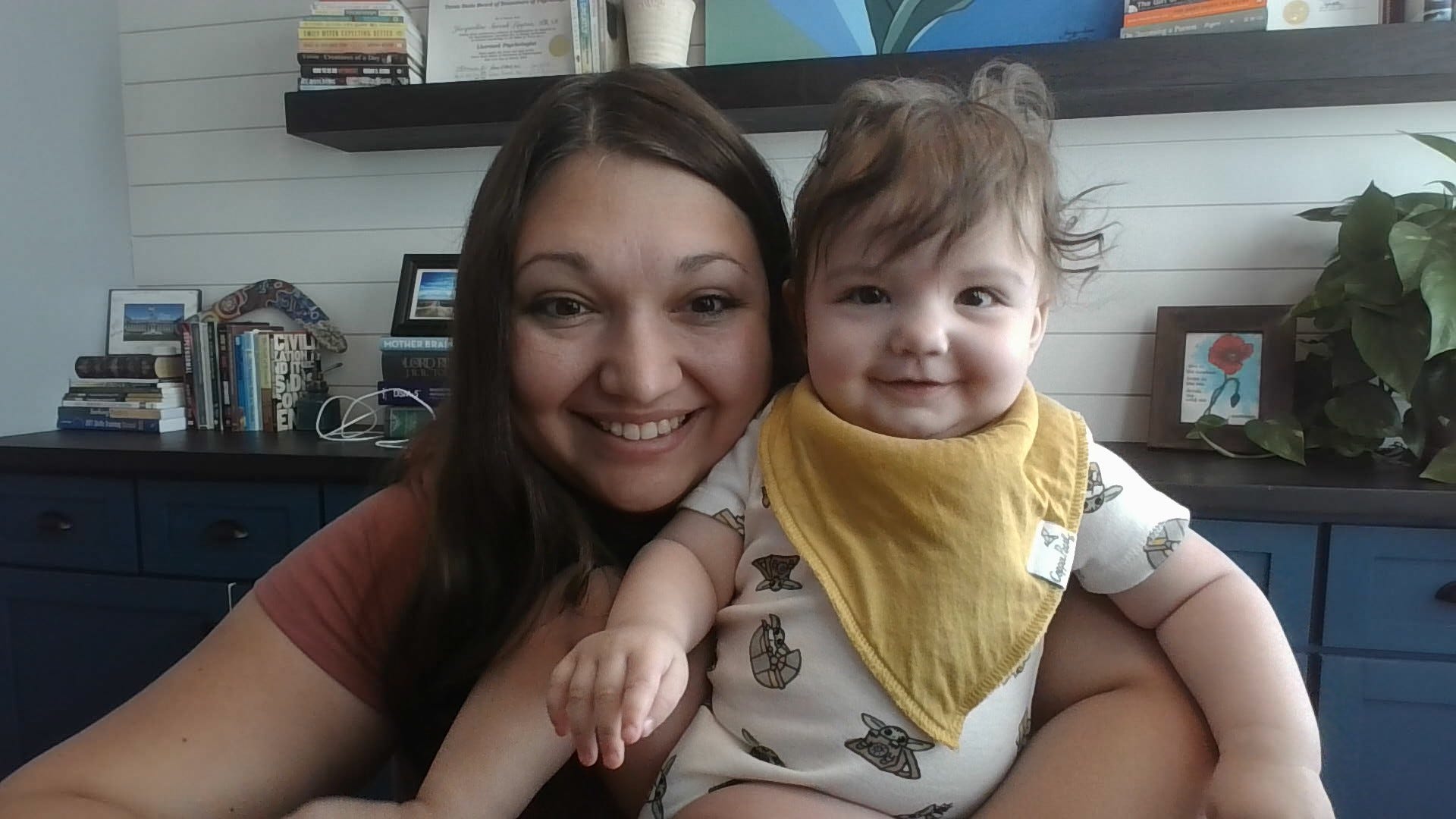
What if instead of trying to silence our emotions, we considered listening to them? I’m a mom of two darling toddlers who are such a lovely reminder of our curiosity, kindness, and delight. And, the ways I talk to these tiny humans has very much changed how I talk to myself.
When one of my daughters makes a mistake, breaks something, or does something “wrong,” I know with my whole heart that they are good and lovely kids. So if they are struggling or doing something unhelpful, I see it as a sign that they need something. Maybe they don’t have that skill yet and need me to show them how to approach a situation better. Maybe they are actually hungry, overstimulated, or need comfort. We may be adults, but we are still human. What if we embraced and loved our humanity rather than trying to numb it out? What if instead of just pressuring ourselves to get it together or get productive, we assumed that we would be if we had our needs met.
Reduce Your Mental Load
I’ll be writing an upcoming letter about how to lessen and even reclaim our mental load. This can be so helpful for reclaiming attention.
There are a number of different pulls on our attention, different weights added to our mental load at any given time. Needs, decisions, worries, notifications, distractions, and time lost to tasks switching or reclaiming attention from shifts between too many things all at once all the time.
Here’s a mental load map (a term I just coined in the moment) to illustrate this:
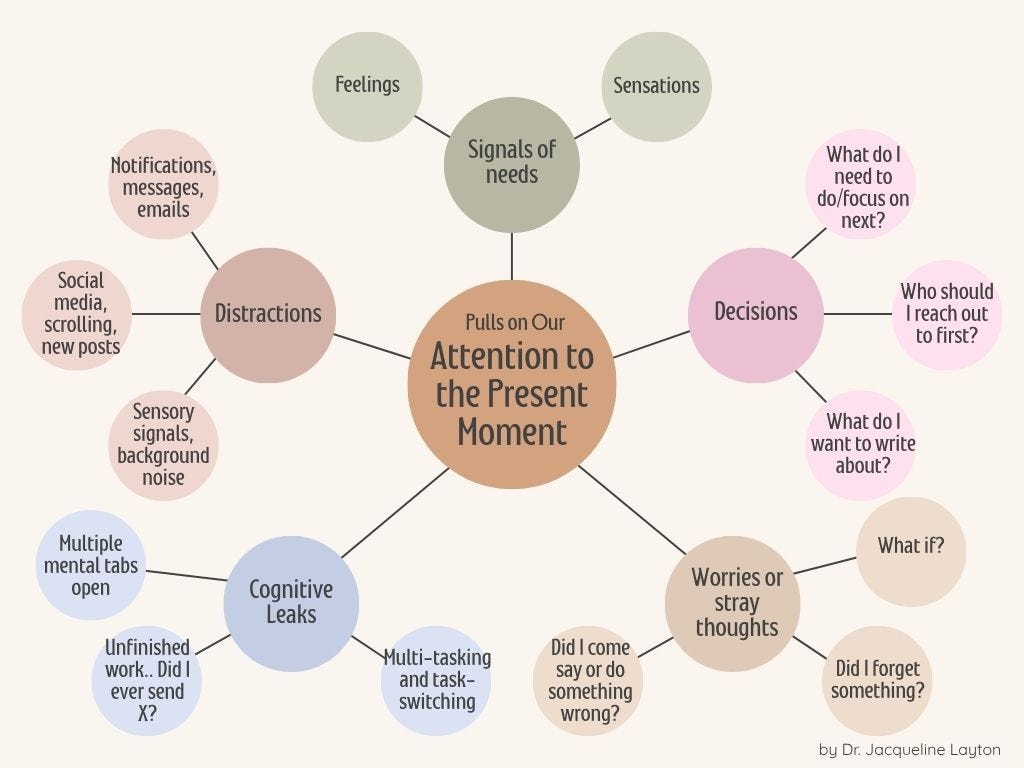
If needs are pulling on your attention, try to meet them. Eat if you’re hungry, seek comfort with a friend if you’re feeling isolated, or take time for sensory soothing when feeling overwhelmed. It may sound obvious but you’d be surprised how many of us forget to care for our own needs when we are trying to finish something.
We can also bring in systems in our work to lessen how many decisions we have to make in the moment, versus what was already planned out all at once at the start of the week by our past selves.
We can be intentional about task-switching (another mental cost and something that requires us to regather our attention), about task and project management so that these to-do’s don’t have to live in our mental load to not be forgotten, and we can make environmental changes. This isn’t necessarily about visual minimalism - you get to have color, art, and even benefit from having things around you that make you feel happy and welcome in your space. It’s more about being able to retreat to quieter spaces for deep work (literally quieter, as certain kinds of noise or commonly cites as our worst distractors).
Don’t Forget the Billionaires Behind the App
Your fractured focus isn’t just a personal struggle you woke up with one day. Nor is it some weakness that led you to be sucked into your phone. The challenges we are all facing collectively right now are the intentional result of a systems that we live under. Unless you are one of the handful of tech bro billionaires destroying the climate and the very social fabric of our societies, this is not on you.
Legal and economic scholars have been writing about “attention markets” and naming the ways our attention has been colonized as one of the most “valuable commodities” in the modern economy.
Our attention has become a precious resource to be extracted from us and sold. This colonization of our very minds and emotions is having real consequences for not only our creative work but also our autonomy and independent thought.
We are losing bits of our making every time we outsource a complex creative or business decisions to AI rather than sitting with it or workshopping it with a trusted peer or mentor. We lose an opportunity to engage in the sort of mental grappling that has helped so many creatives find their way out of uncertainty. I’m not saying not to use tools of course. Some genuinely help and there are a number of factors to weigh. I get that. But I do want to remind you of something important, especially if we remember how our behavior changes our brains.
These moments of choosing convenience and outsourcing our thinking are also quietly eroding the daily struggles and friction that is actually our practice of problem solving and thinking. If you do it enough, you’re training yourself not to think as creatively or actively.
And I want you to ask yourself: Who does that serve?
Resist Being a Resource for Harvest
It’s also worth mentioning that our society has inundated us with messaging that the time we spend in working hours is more valuable than time outside of work. Free time and play have been demoted from core parts of living and learning, to frivolous. Rest has been demoted from a necessity to a luxury. The hours of our lives we sell as labor are seen as valuable whereas after work, our time feels cheap. We are so tired perhaps, or have been left so few mental resources after long working days, that the portion of our lives left for actually living are the part that we check out from by scrolling, or by watching TV or YouTube.
This is important because of how deeply important rest, stillness, and even boredom are for our creativity. The constant barrage of media rushes us through the internal proofing period when our creative dough used to rise.
Our society has also long regarding the time and focus of some members to be of less value than others. We are bringing in these interruptions on top of existing wounds that go back far before the smartphone. Creative and domestic labor (especially in its association with women’s labor) has long been treated as something we can more readily interrupt without apology. Young peoples’ time is also something often treated as not-yet-valuable in a capitalist society, and therefore as something to fill or harvest rather than protect. We have a long history of treating the attention of some people as less deserving or protection or respect than that of others. The attention of people who are wealthy and powerful has already been “valued” above ours for some time now. This latest use of technology is certainly increasing the rate, harm, and impact of extraction, but the extraction part is definitely not new.
As a maker or creative entrepreneur balancing your craft, business, personal needs, and possibly several other forms of invisible labor, this history may land closer to home for you. Reclaiming your attention is not just a productive strategy, but a radical and important refusal. Your attention is not a public resource and neither is your time.
Sensory Pause
I’d encourage you to look around at something across the room that isn’t a screen. Notice 4 things you can see in the room around you. As you do so, inhale through your nose and exhale slower than you inhaled through your mouth. Like smelling flowers for 4 seconds and blowing out birthday candles for 6 seconds. What are 3 things you can physically feel in your body or around you (e.g., the air conditioning, the weight of your feet on the floor, the texture of your phone case or clothing)? What are 2 things you hear around you? What’s one thing you can taste or smell?
Reclaiming your attention isn’t just about finishing all of the different partially-done projects, catching up on emails or your to-do list, or feeling productive. Those are just some of the outcomes. I want you to reclaim your humanity, autonomy, and thinking.
Fall into Flow
Psychologist Mihaly Csikszentmihalyi studied a concept called “flow,” a state of being so genuinely absorbed in meaningful work that your self-consciousness and even sense of time can fall away. For makers, this is a lovely state of being fully present and attuned in what we are doing. Flow isn’t really about productivity. It’s when challenge meets skill and interest in a harmonious way so that your full attention is settled on the task and present moment.
You can experience flow by finding activities that are deeply interesting and fulfilling to you. This is about allowing yourself to fully sink into what you are doing. It may even help to leave your phone in another room. If you worry about being late for something or whatever else, you can always set a timer so that you can trust that you don’t have to look at the clock or worry about how much time is passing.
This is a deep contentment, joy, and absorption. Even if you shoot for flow and fall just a bit short, it will probably still be a rewarding, soothing experience. And will definitely still be a great exercise in sustaining attention.
Practice Gentle Attention
There are some lovely ways to practice holding attention without feeling overwhelmed or struggling. You can do things that gently hold your attention, such as repetitive craft (e.g., knitting), simple moving activities (e.g., contour drawing and sketching), and exercises of intentional noticing.
One of my favorites is to bring in that noticing or mindfulness periodically through my day. If you are doing something, try to just do that one thing. If you are sketching, take the time to just sketch. If your mind starts to wander to worries or to-do list items, gently invite yourself back. It will still be there in a few minutes. Notice the sound of the pencil scratching on the art pad. Or the feel of it in your hand. Notice where you get tension in your hand, arm, or even shoulder when you draw.
This can also be done with music, poetry, or working in the darkroom processing photos. Notice the rhythm of your craft. As you’d listen to and feel the waves at the beach.
Taking Back Slowness
Philosopher Byung-Chul Han described ours as an “age of haste,” where time moves so fast that our moments blur and we lose our hold on slower modes like wonder, curiosity and deepened reflection. I feel a weight in my chest thinking about it, because these are the very things that give life to our creative work and lives. His answer isn’t to escape the world (I mean how could we really), but to re-engage with parts of it that near-term urgency (deadlines, algorithmic pulls on our attention) crowd out. This can mean slowing down for a nature walk, meditation, or a long and slow engagement with something (e.g., painting, a good book, even staring at the clouds overhead like we used to do as kids). This part of the process may even look from the outside like you are doing nothing at all.
Phew! You made it all the way through this letter. I sincerely hope that it gave you interesting things to think about, some real exercises and practices you can use, and an insight into how important and lovely your attention is.
Congratulations also on reading through this very long letter as an act in itself of practice and strengthening your sustained attention. I know there are a lot of massive forces around us changing our society really quickly. But I still sincerely believe that we as makers have the ability to reconnect us. Each moment we make as a human, and reach a fellow human, we are restoring and reclaiming that connection.
That’s why I’ve started Beneath the Making. I sincerely believe that you in your lovely, messy humanity matter. And I want you to keep being that wonderful human self. If putting these letters together can help with that in any way, it’s worth it.
In warm solidarity,
Dr. Jackie
Beneath the Making
Sources & Further Exploring for the Curious:
(Link to Book) Csikszentmihalyi, M. (1990). Flow: The psychology of optimal experience. Harper & Row.
(Link to Article) Hilman, E. (2024). This is your brain on social media: How social media use is changing our attention spans. Research Archive of Rising Scholars. https://doi.org/10.58445/rars.1860
(Link to Article) Mark, G. (2022). Multitasking in the Digital Age. Springer Nature.
(Link to Article) Posner, M. & Patoine, B. (2009). How Arts Training Improves Attention and Cognition. Cerebrum: The Magazine that Can Change Your Mind. 12.
(Link to Book) Schwartz, B. (2016). The paradox of choice: Why more is less (Revised ed.). ECCO.
(Link to Article) Shane, Aidan (2025) “Understanding the Attention Economy and its Negative Effects: Consumerism is Consuming Us,” Intertext: Vol. 33, Article 13.
(Link to Podcast) Speaking of Psychology podcast episode with Dr Gloria Mark on attention spans
(Link to Article) Wadlinger HA, Isaacowitz DM. Fixing our focus: training attention to regulate emotion. Pers Soc Psychol Rev. 2011 Feb;15(1):75-102. doi: 10.1177/1088868310365565.
(Link to Article) Waters, J. (2021) Constant craving: How digital media turned us all into dopamine addicts. The Guardian.
Note: This was also posted on my Beneath the Making substack.