
The Making is the Masterpiece
How we fall in love with the toil and curiosity of the writer
As a child, I used to watch the Jurassic Park movies over and over again. I read the book later, finding it even more layered and rich in detail. I was in the car with Tim and Lexi, in the massive gaze of the tyrannosaur. My breath caught as a huge head came down on the hood of the car. I was caught up in the sensory experience in my mind while reading - the pouring rain, the muddy splashes, and the shrill metallic scrape of claws on the roof of the car. The “pebbled, leathery flesh,” of a dinosaur brought back to life.
We don’t just fall in love with stories, but in how people choose to tell them. The creative works that stay with us carry traces of the people beneath the making - their curiosity, passions, collaborations, uncertainty, learning, fears, and sensory attention - and those little signs of the people beneath the work invite us to participate in the psychologically rich and deeply human experience of meeting a maker in their art.
There are so many examples of this, but the types of work I want to explore in this essay are the works that emerge slowly and in unique detail. I want to talk about the way we experience stories by delightfully nerdy and passionate authors. Authors who chased mysteries, went deep into rabbit holes, and obsessed about the craft they were creating.
I want to talk about the ways the fervid curiosity of writers is contagious.
We don’t just fall in love with stories, but with the people curious enough, dedicated enough, and perhaps awed enough to make them. Some of the stories that mean the most to me are ones where the writer, through the pure passion for their craft, drops you into their own wonder and curiosity. And you find yourself in a world so detailed and layered - so alive from the writer’s gatherings - that you can’t help but feel wonder and awe yourself.
There’s a bit from Jurassic Park that illustrates this:
“Visitors found the Badlands depressingly bleak, but when Grant looked at this landscape, he saw something else entirely. This barren land was what remained of another, very different world, which had vanished eighty million years ago.
Stories that so capture the perspectives and passions of the author and characters enlighten us to things we’d otherwise miss. The way a paleontologist can look at the sandy, barren Badlands and imagine another world, 80 million years in the past, when Pterosaurs swooped down to scoop algae from the surface of an ancient inland sea.
And then there are these delightful moments in the Martian:
It’s a strange feeling. Everywhere I go, I’m the first. Step outside the rover? First guy ever to be there! Climb a hill? First guy to climb that hill! Kick a rock? That rock hadn’t moved in a million years! I’m the first guy to drive long-distance on Mars. The first guy to spend more than thirty-one sols on Mars. The first guy to grow crops on Mars. First, first, first!
Mark Watney turns to humor, amusement, wonder, and even his faith in humanity. H He turns to forgiveness and humility. And we see the complexity of his situation. He is afraid all of the time, but even in terrifying ordeals there are other moments. There are other things our minds do. And we use them like footholds as we climb. Something I love about the Martian isn’t just the interesting interweaving of science into the realistic problem solving and survival, but the psychological hurdles he is continuously overcoming. It made the story more real, with a character who was brilliant and brave and so very human.
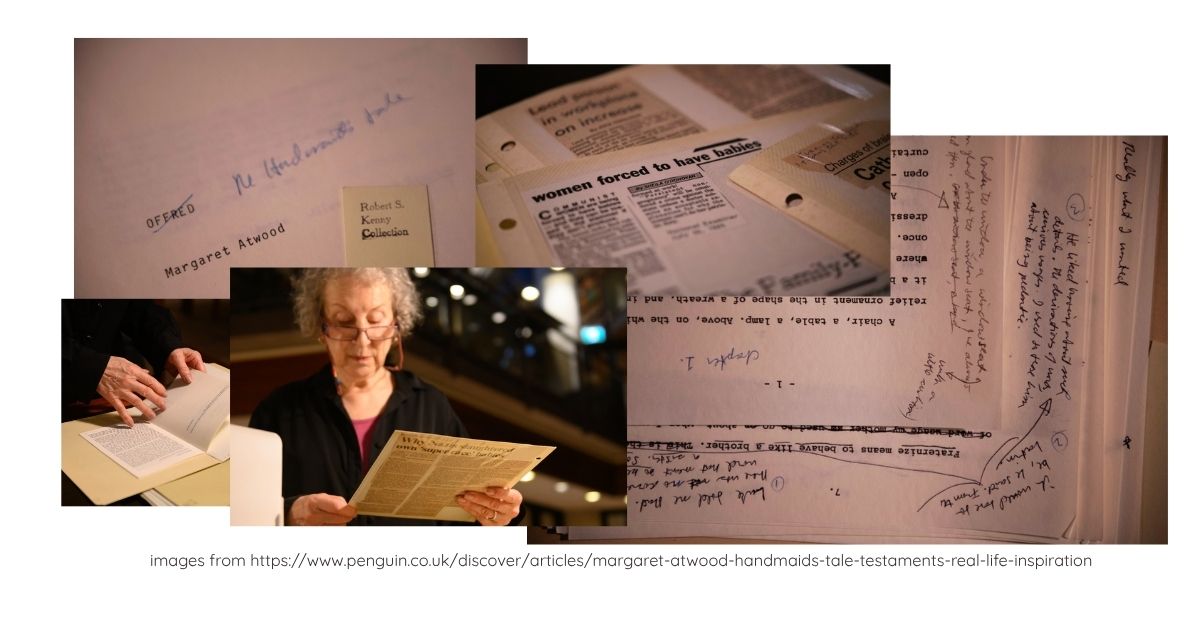
I also think of the way things crumbled in the Handmaid’s Tale:
That was when they suspended the Constitution. They said it would be temporary. There wasn't even any rioting in the streets. People stayed home at night, watching television, looking for some direction. There wasn't even an enemy you could put your finger on.
So much of what we see in history, and sadly since the writing of this novel, so much of what we have seen in the US are crises, discussed for a brief period before the news cycle moves to another crisis. The way people held on to their old assumptions and reality, waiting for direction, and making only small changes to their beliefs about the country and institutions (rather than massive changes in trust to befit the massive changes in the country) is a deft illustration of hyper-normalization. Of why people looking back with historical context will ask why people were not rioting in the streets rather than continuing to go to work each day.
Writers who carefully craft these layered worlds help us experience our own. Writers obsessively gather the details we’ve unknowingly lost to our tired autopilot, and offer them to us in a fresh context so we can notice and experience.
Through writing and art, research and curiosity, creatives can live in richer, newer, deeper ways, and invite others to do the same. They help us re-experience and re-think the ordinary. It’s a truly lovely gift to give and receive.
Parallels with Therapy
I still think about an engineer who described how all around him are machines and things that have a certain rationale. In a way, he had a knack for picking up the new language of certain types of devices and machines. And once he understood their rationale, they all become approachable and fixable to him.
I think of an architect I saw who could look at a surface or building most of us would miss, and in her mind’s eye she could picture how water would roll over that surface, and where it would pool up. She imagined the ways buildings lived and were lived in over time and imagined a world more sustainably and beautifully built.
And I remember a mom looking at each thing around us with a new light - how she saw the whispers in all corners of her American city that showed it had been built primarily for men and production. Certainly not for her or her tiny child. She saw the possibilities of all the ways society and the spaces we move in could be more welcoming if we created them with families in mind.
In so many ways, writers invite us to see the world through their mind’s eye or through the mind’s eye of their characters. And for just a moment, we get to be the loving therapist, stepping into someone else’s world, simply trying to understand and see.
To Be Transported
There are so many examples of what I’m going to call “transportational” works in fiction. I’d love to hear what stories come to mind for you. In the comments, can you share examples of stories that had you falling into their offered wonderland? What works changed how you thought about something - however big or small? What works transported you into a new way of experiencing?
I don’t think we resonate with aesthetic or pretty words alone. I think we’re drawn towards the childlike curiosity and discovery that used to be our entire way of experiencing the world. I think some part of us wants to see the world around us afresh again. And in that way, the creative works that are rich, complex, and novel are also an experience of aliveness.
You may have noticed this not just in works you experienced, but in those you’ve personally worked on.
I think of books I started writing over the years just for fun. As a kid, I’d bike to the local public library, and move through the shelves and decimal points until I found the specific books I wanted to gather for my latest project.
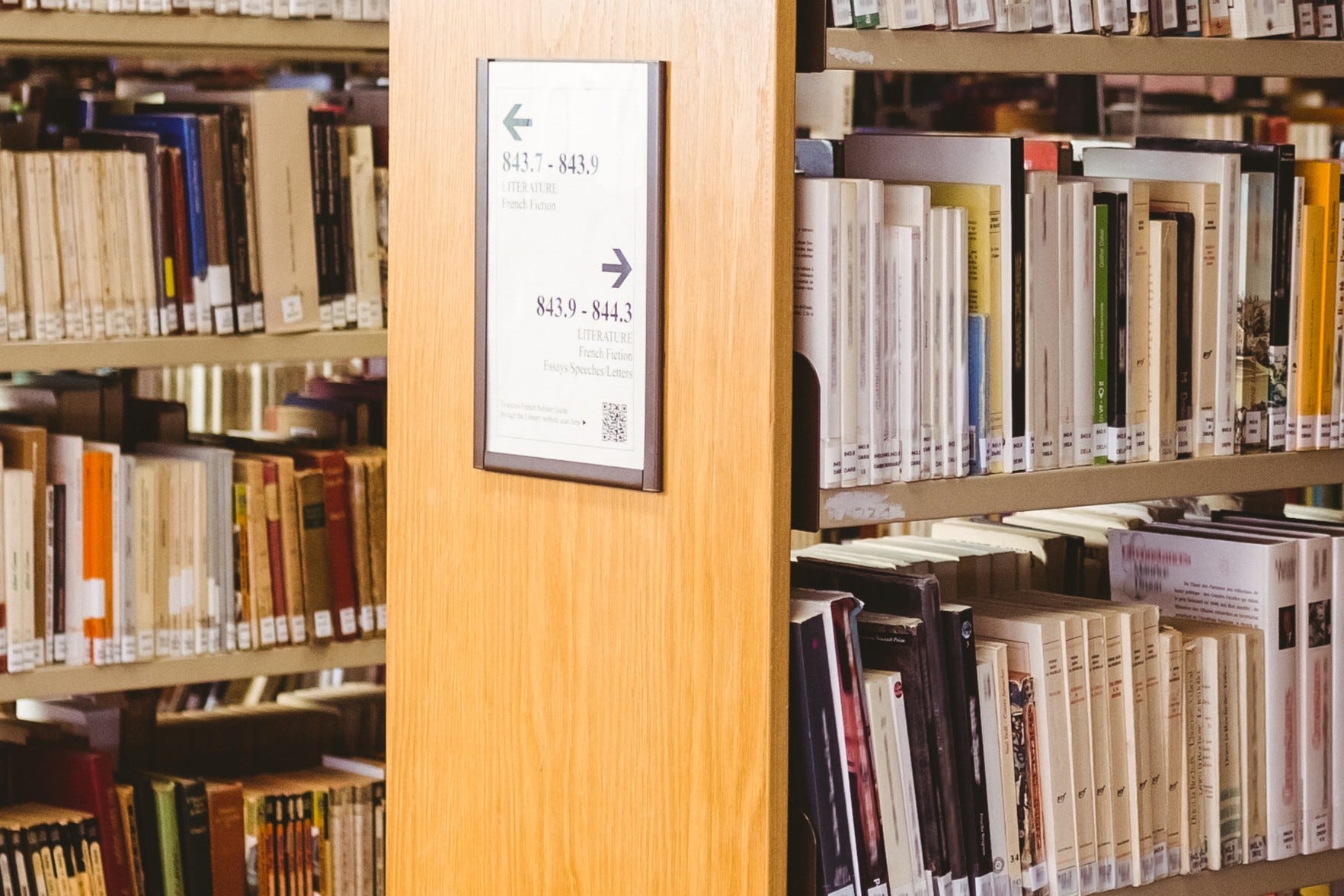
At one point, I was writing about a character facing powerlessness and poverty, and fighting back against it in all the ways I was convinced I wouldn’t. That led me to explore all sorts of things about where this character went. I cared about this character, and wanted to know them in a real way. I wanted to do their story justice. It’s something I now recognize as one of the many layers of loving my daughters - I want to truly know them and do right by them, whatever that may mean. It was like this for me for my characters.
I was also deeply fascinated by the storm he found himself caught up in. So I was there, a teen at a local library, gathering books on organized crime and money laundering. I was happily working in the cocoon of privacy that was unique to a kid in the 90s and early 00s. No watchlists needed be updated based on my perusing. No one know, except may the librarian. And she just chuckled and told me to loop her in if my schemes ever started making bank.
I’m not sure if the depth of research we do is an act of love for our characters, a deep possession by curiosity, or some combination. But it’s one of the things I most love about humans. We develop these deep, specific interests and can go to such depths in exploring them. We allow ourselves and invite others to be transported.
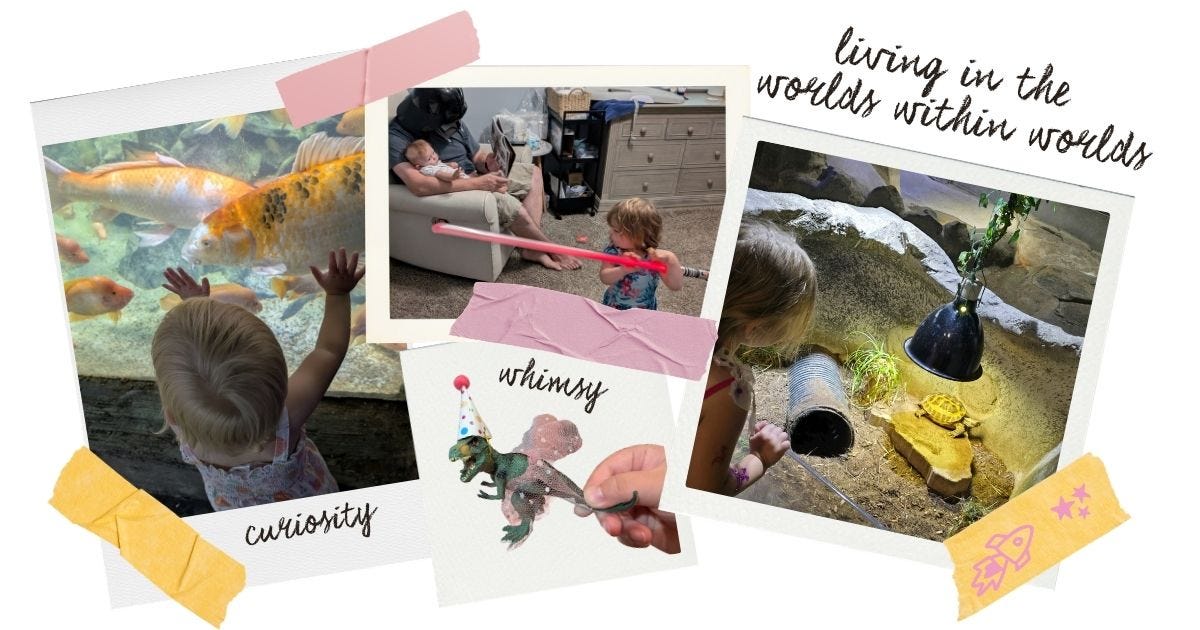
There’s something so joyous and also so connecting about seeing another writer who took to the depths for their craft. I saw this in Jurassic Park as a kid. Michael Crichton asked questions about whether DNA could be preserved across millennia. He talked about how even as a parent his mind continued to return to dinosaurs over the years. He bought dino stuffies for his daughter, saw the wonder in kids reacting to dinosaurs at the Natural History museums, and wondered about how children would react to the idea of a zoo with dinosaurs. As a fellow parent, I see my daughters light up at the idea of dinosaurs and outer space and creatures big and small. And their delight can re-spark our own wonder and awe.
I felt this when reading the Lord of the Rings, seeing the depths and layers of the world Tolkien had created. There were cultures, histories, and even entire languages here. Tolkien’s curiosity and passion had created an entire Middle Earth. And something delightful happens when we step openly into new lands and worlds, our senses and curiosity wide open to possibility. We are so much more open to learning and changes in ourselves too. There are things I learned about humanity through wide open curiosity that all those years of classes and college never taught me. We just approach it so differently.
Experiencing the steady hearts of hobbits, the brave children facing too-large things in Panem, the careless commercialism of a dinosaur park, the vast solitude of a mission to Mars gone oh-so-wrong, the too-close and too-familiar moments in Margaret Atwood’s Gilead, and on and on.
These authors were fellow questioning, exploring, and at times perhaps flawed people just like the rest of us, but I love each of them for giving us worlds that helped us see and experience our own anew.
Making is the Masterpiece
We talk about masterpieces like they’re acts of talent, but I think that flattens a far more beautiful human process. We love their work because of all the little things - the tiny, carefully uncovered details - that another person cared enough about to effortfully discover and share.
I can imagine the months and years the person spent thinking about this very thing. Jotting down ideas on napkins or travel notebooks or margins, as this work of love and curiosity took its gradual and complex shape.
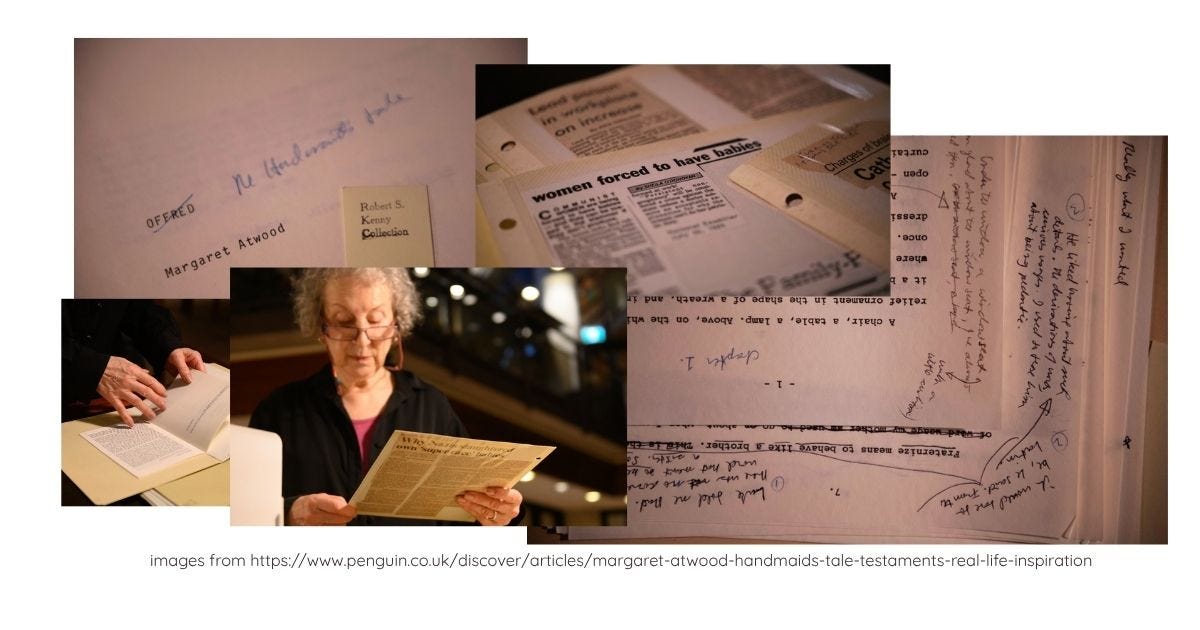
I imagine Margaret Atwood gathering her box of newspaper clippings. And the moment Michael Crichton was reading about flies in amber and reached out to a lab that discovered we could capture DNA from far further back than we’d ever imagined possible. I think of Andy Weir spending months collaborating with people in their own passions and curiosities on his blog who joined him in wondering how Mark Watney could farm potatoes in space. I think of the curiosity that became communal acts of discovery.
At the heart of such different stories - the hard science of a Mars mission, the hubris of a dinosaur theme park, the horrors of theocratic authoritarianism - were people following questions deeper. Each of these authors shared hints in their interviews of the many ways they asked, “What if?”
What if these attitudes I’m hearing gained enough power to be elected in the US? What if someone could apply these methods to bring dinosaurs back? What if a person was stranded entirely alone on Mars?
I think those deep, intertwining roots beneath creative work are things I love as much - maybe even more than - the creative works themselves. I love living in a world where a person can spend years thinking about Mars. And another can collect newspaper clippings, research, and texts for years on authoritarianism. And another can keep coming back to dinosaurs again and again.
Each of these works became critically acclaimed and adapted to the screen eventually. But at first, they were just a project someone could not let go of. A participation of minds, talking about a strange idea.
How many novels are being created right now on Substack, one conversation or notes thread or posted chapter at a time? Being fine-tuned through an act of shared curiosity and nerdiness.

Curiosity is an act of love for one another, ourselves and the world in so many ways. It’s at the core of making, writing, and creating. It’s at the core of living a psychologically rich life. It’s what makes our minds malleable enough to move and change and dance with others around us.
I think a work feels alive to us not only because it’s well written or convincing, but because we can feel the ways the person behind it was paying attention. And we love the experience of following them into their wonder, their uncertainty, their fears and their imaginings. Curiosity and art are connectors.
And I think it isn’t the delight of art we fall in love with then - it’s the delight of one another.
Here’s to you and your making,
Dr. Jackie
P.S. If you found this interesting, stay tuned! I will continue to post these letters both here and on Substack. If you'd like to comment, engage, and chat with me direclty about this post, you can comment on Substack as well. These letters (and commenting on them) are free and public!